
By: Brian Seay, CFA | Capital Stewards
Your company was sold and your ESOP Is paying out. Now what? What do you do when the biggest check of your career shows up all at once?
If you work at an employee-owned company here in Huntsville and that company just sold, you may be about to control more money than you ever have. And I'll be honest: how you handle that can matter almost as much as the years of work it took to build that balance.
In January 2020, Leidos closed its $1.65 billion cash purchase of Dynetics, the Cummings Research Park firm that had been employee-owned since 1974. The Dynetics ESOP was terminated, and a recent study of ESOP distributions puts the payout at roughly $977 million to about 2,260 people across 2019 and 2020. At the time, CEO Dave King said the deal would create "a lot of millionaires."
This fall, it happened again. On October 1, Blackstone announced it would acquire Technology Service Corporation (TSC), which was 100% owned by its ESOP and has long had an office in Cummings Research Park. TSC is being combined with Applied Systems Engineering to form a new defense company called Falcata. Terms weren't disclosed publicly.
And there's more coming. Since 2020, Huntsville firms like Avion Solutions, Thompson Gray, CFD Research, Aviation & Missile Solutions and Invariant have all moved to 100% employee ownership. That's a lot of families building real wealth in ESOP accounts. Whether your payout comes from a sale like Dynetics or TSC, or simply from retiring out of a company that stays employee-owned, most of what follows applies to you.
So let me walk through how an ESOP actually works, what happens to it when the company sells or when you retire.
How an ESOP Works, in Plain English
I've found that a lot of employee-owners know their balance but not much about how the plan works. That's understandable. Nobody hands you a manual. But it matters now, so here's the short version.
An ESOP is a retirement plan that invests mostly in the stock of the company you work for. It's governed by the same federal rules as a 401(k), which is why the tax rules on the way out will look familiar.
A trust owns the shares, not you. An ESOP trust holds the stock on behalf of everyone, and a trustee acts as the legal shareholder.
The company funds it. Shares get allocated to your account each year, usually based on pay. Unlike a 401(k), you typically don't put in a dime.
You earn it over time. Vesting can take years. Leave early and the unvested part goes back to everyone else.
An appraiser sets the price. There's no stock ticker, so an independent appraiser values the company at least once a year.
You get paid when you leave. Normally the company buys your shares back after you retire or separate, often in installments over as long as five years.
That last point is why a sale is such a different animal. In a normal ESOP, money trickles out slowly as people retire. In a sale, everyone's account turns into cash at the same time, at whatever price the buyer paid.
What Happens to an ESOP When the Company Is Sold
When a private equity firm or a big strategic buyer purchases a 100% ESOP-owned company, the ESOP almost always sells its shares for cash and then shuts down. The trustee negotiates on your behalf, and federal law requires the trustee to get at least fair market value.
Usually three things follow:
Your account becomes cash. The company stock in your account is replaced by your share of the sale proceeds. You don't own the company anymore. You own a retirement account full of cash.
You become fully vested. When a qualified plan terminates, the tax code requires everyone to be 100% vested. If you were two years into a six-year schedule, congratulations. The rest is yours.
The plan winds down. The ESOP is formally terminated and the money gets paid out, usually within a year or two of closing.
Sometimes the buyer merges the ESOP into its own 401(k) instead. Either way, the big change is the same: your balance stops riding on one company's stock and becomes money you have to make decisions about.
If you're staying on with the new owner, your job continues. Your retirement plan is what changes. Many folks will see a new 401(k) match, and some leaders may get new incentive equity from the buyer. That's a different conversation with different rules.
When the Money Actually Arrives
Here's the part that surprises people: you probably won't get one check. Expect your payout in stages, and expect the last piece to take a year or more after the deal closes.
A typical sequence looks something like this:
The deal closes. Sale proceeds flow into the ESOP trust and your account converts to cash.
Some of it gets held back. Deals commonly park part of the price in escrow to cover post-closing adjustments. Trustees also tend to keep a reserve in the plan until the IRS issues a "determination letter" blessing the plan's termination.
You get an election packet. It shows your balance and asks how you want the available amount paid: rolled over, cash, or some of each.
The first distribution goes out. Usually the large majority of your balance.
The rest follows. Once the IRS letter comes back and escrows release, a final distribution clears out the plan. Attorneys who work these deals note the IRS review alone can run past a year.
Two practical takeaways. First, you'll probably make this decision more than once, so set up the receiving account so it can take later deposits. Second, don't spend money you haven't received yet. Escrows can come in lighter than expected if the buyer makes claims against them.
Your Options for the ESOP Payout
For most people, my view is that a direct rollover into an IRA or your new employer's 401(k) is the right default. It keeps every dollar working and defers all the tax. Taking cash results in paying taxes on the withdrawal, which can be an expensive choice. Sometimes it's the right one, but it should be a deliberate decision, not a default.
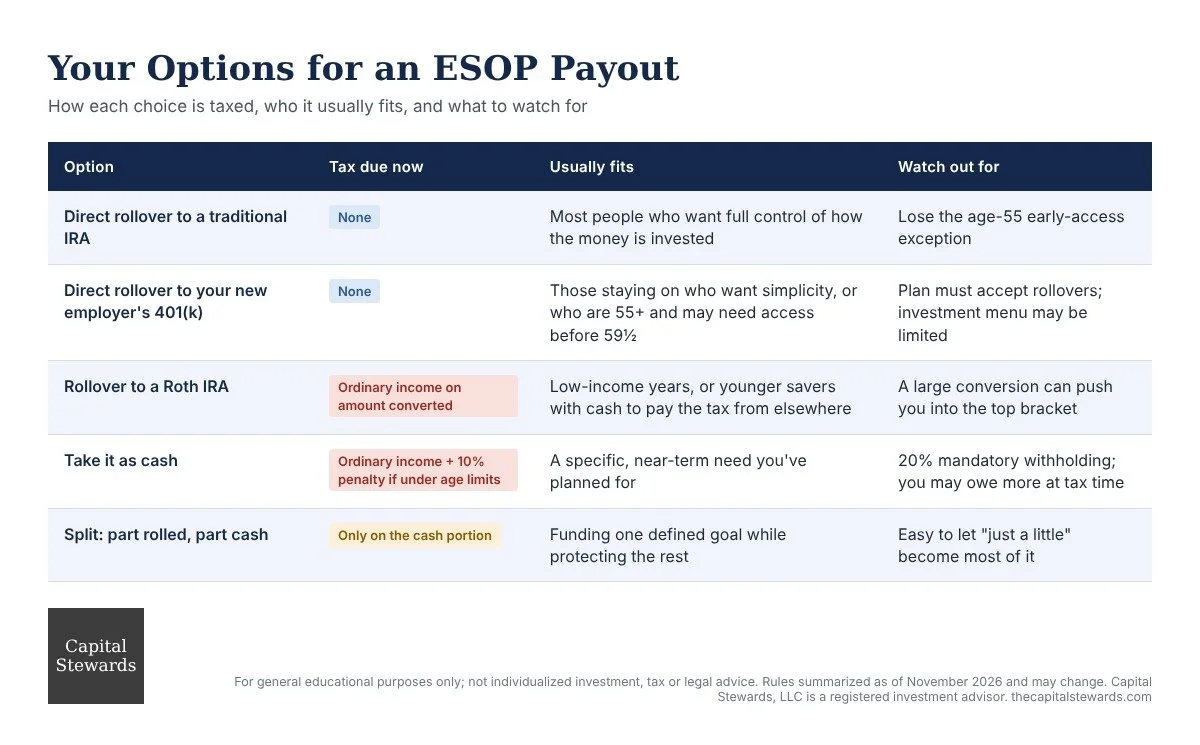
Pay attention to the word "direct." A direct rollover moves the money from one custodian to another with nothing withheld. If the check is made out to you, the plan has to withhold 20%. You then have 60 days to deposit the full amount, which means coming up with that missing 20% out of your own pocket, or you'll owe tax on the gap. I've seen this one catch smart people.
Four Tax Traps to Avoid
The biggest risk with an ESOP payout usually isn't the stock market. It's an avoidable tax bill. These are the five I'd check before signing anything.
1. Stacking a cash payout on top of your salary
Any amount you take as cash is taxed as ordinary income in the year you get it, right on top of your wages. A $300,000 cash-out on a $150,000 salary can push a big chunk of that money into the 32% or 35% federal bracket, and larger amounts reach 37%. If you need some cash, ask whether you can spread it across two tax years.
2. The 10% early withdrawal penalty
Cash taken before age 59½ generally carries a 10% penalty on top of the income tax. There are exceptions for death, disability and a few other situations. "I wanted to pay off the house" isn't one of them.
3. Rolling to an IRA too fast if you're 55 to 59
If you leave your employer in or after the year you turn 55, you can usually take money out of that employer's plan without the 10% penalty. That exception doesn't follow the money into an IRA, where the age is 59½. If you're in that window and may need to draw on the money soon, keeping some of it in an employer plan, or taking a planned amount before you roll the rest, can save real dollars.
4. Counting on NUA when it probably isn't available
You may come across "net unrealized appreciation," a strategy that lets some people pay capital gains rates on company stock coming out of a retirement plan. It generally requires distributing actual company shares. After a cash sale, your account holds cash, not shares, so NUA usually isn't on the table. But if you do end up with shares in the new company, consult a tax advisor on your options.
Planning Beyond the Rollover
Rolling the money over solves the tax problem. It doesn't answer the bigger question: what is this money for? An ESOP payout is a good example of a big financial decision that requires wise stewardship. It's the result of years of work alongside your colleagues and it may be the single largest payout you receive in your career.
You just got diversified. Don't undo it.
For years, your paycheck and your retirement both depended on one company. The sale fixed that for you. I have seen people reinvesting heavily in defense primes or the handful of tech names they know best. Familiarity feels like safety. It isn't. It just rebuilds the same risk you were handed a way out of.
Have a plan for the cash before it lands
Rollover money often sits in cash while the paperwork clears. That's fine for weeks, not months. Decide ahead of time whether you'll invest it all at once or phase it in on a set schedule, and write the schedule down. Otherwise the headlines end up making the decision for you.
Look for Roth conversion windows
If you're retiring early or between jobs, you may have a few low-income years before Social Security and required distributions kick in. Converting part of a large traditional IRA to Roth in those years can lower your lifetime tax bill. That's especially true for married couples who want to avoid a widow's tax squeeze down the road.
Watch who's calling you
A public deal announcement puts a target on employee-owners. Expect pitches for annuities, insurance products and "exclusive" investments. Before you hand anyone your rollover, ask two questions. Are you a fiduciary at all times? And how exactly do you get paid? There are no shortcuts here. Do the diligence.
Questions to Answer Before You Sign the Election Form
Your distribution packet will come with a deadline, but in my experience you usually have time to get these answered first:
☐ What is my total vested balance, and how much is being paid now versus held back?
☐ When does the plan expect the final distribution, and will I have to make a new election for it?
☐ Does my new employer's 401(k) accept rollovers, and how do its fees and fund choices compare with an IRA?
☐ Am I 55 or older, and could I need any of this money before 59½?
☐ If I take any cash, how much will be withheld, and what will I actually owe in April?
☐ Should any cash be split across two tax years?
☐ Do I have other old 401(k)s or IRAs that should be consolidated at the same time?
☐ Are my beneficiary designations set on the new account?
☐ What is this money for, and what investment plan gets it there?
Frequently Asked Questions About ESOP Payouts
What happens to my ESOP if my company is sold?
In most private equity sales, the ESOP sells its shares for cash and the plan is terminated. Your account becomes fully vested, converts to cash, and is paid out to you or rolled over, usually in stages over the following year or two.
Do I have to pay taxes on my ESOP payout?
Only on the portion you take as cash. A direct rollover to an IRA or another employer plan defers all federal and state income tax until you withdraw the money later.
Can I roll my ESOP into an IRA while I still work for the new owner?
Generally yes. A plan termination is a distribution event, so you can usually roll your balance to an IRA even if you keep your job with the buyer.
How long does an ESOP take to pay out after a sale?
Most participants receive the bulk of their balance within months of closing. A final holdback often waits for escrow releases and an IRS determination letter, which can take a year or more.
Is it better to roll an ESOP into an IRA or a 401(k)?
An IRA usually offers more investment choice and control. A 401(k) can make sense for simplicity, or if you are 55 or older, have left the employer, and may need money before 59½ without the 10% penalty.
Should I pay off my mortgage with my ESOP money?
Maybe, but run the after-tax math first. Taking cash to pay off a low-rate mortgage can trigger income tax, a possible 10% penalty and Alabama tax. In a lot of cases that costs more than the interest you'd save.
So, What Is This Money For?
Before you sign that election form, I'd encourage you to pause and wrestle with a few questions.
What do you want this money to do? Is it retirement security? Freedom to change careers? Your kids' education, or a legacy you want to leave? Being generous to people and causes you care about? Is your plan for the money actually lined up with those answers?
An ESOP payout is a once-in-a-career decision, and the right answer depends on your age, your tax picture and your goals. If your company has sold or is about to, start a conversation with us.
Important Note
Capital Stewards is not affiliated with Technology Service Corporation, Falcata, Blackstone, Leidos, Dynetics or any other company mentioned; deal details come from public announcements.